Calculating Your Golf Handicap Under the World Handicap System
The World Handicap System (WHS), introduced in 2020, unified six different handicap systems into one global standard. Whether you play under USGA, Golf GB&I, Golf Australia, or any other national body, the underlying math is now the same. This calculator covers the three most common handicap tasks: converting your Handicap Index for a specific course, getting a rough estimate from a single round, and computing an index from multiple rounds.
The Course Handicap and Score Differential formulas follow the current WHS rules published by the USGA and The R&A. Quick Estimate shows the Score Differential from one round. Index from Rounds applies the WHS 3-to-20 selection table, but it remains an estimate because an official scoring record can also include safeguards and committee adjustments.
Course Rating, Slope Rating, and Par
Course Rating is the expected score a scratch golfer (handicap 0) would shoot on that set of tees under normal conditions. It is always expressed to one decimal place, like 71.4 or 68.9. This number is not the same as Par. A par-72 course might carry a Course Rating of 73.8 from the back tees and 69.2 from the forward tees.
Slope Rating measures how much harder the course plays for a bogey golfer compared to a scratch golfer. It ranges from 55 (very flat difficulty curve) to 155 (huge gap between scratch and bogey), with 113 as the standard baseline. A Slope of 135 means the course is significantly more punishing for higher-handicap players than for low-handicap players – perhaps because of forced carries, narrow landing zones, or severe rough that scratch players routinely avoid.
Both ratings are set by an authorized golf authority through on-course evaluation. You will find them on the scorecard, on the club’s website, or in your country’s course rating database. Quick Estimate can use 113 and par as rough fallbacks, but an exact Course Handicap requires the published ratings for the tees being played.
Score Differentials and the Selection Table
A Score Differential standardizes your round against the difficulty of the course. The formula is (113 / Slope Rating) x (Adjusted Gross Score – Course Rating – PCC). This strips out the course difficulty so a 92 on a tough course can be fairly compared with an 85 on an easy one.
When you have a scoring record of 20 rounds, the WHS takes the 8 lowest differentials and averages them. For fewer than 20, the number used and any adjustment changes:
| Scores Available | Differentials Used | Adjustment |
|---|---|---|
| 3 | Lowest 1 | -2.0 |
| 4 | Lowest 1 | -1.0 |
| 5 | Lowest 1 | 0.0 |
| 6 | Lowest 2 | -1.0 |
| 7-8 | Lowest 2 | 0.0 |
| 9-11 | Lowest 3 | 0.0 |
| 12-14 | Lowest 4 | 0.0 |
| 15-16 | Lowest 5 | 0.0 |
| 17-18 | Lowest 6 | 0.0 |
| 19 | Lowest 7 | 0.0 |
| 20 | Lowest 8 | 0.0 |
The negative adjustments for 3 to 6 scores exist because a small sample tends to overrepresent your best play. The system compensates by pulling the index down slightly, which gets corrected naturally as you post more rounds.
Adjusted Gross Score
The WHS does not use your raw gross score. It uses an Adjusted Gross Score, which caps each hole to prevent blow-up holes from inflating your handicap unfairly. The cap depends on whether you already have an established Handicap Index.
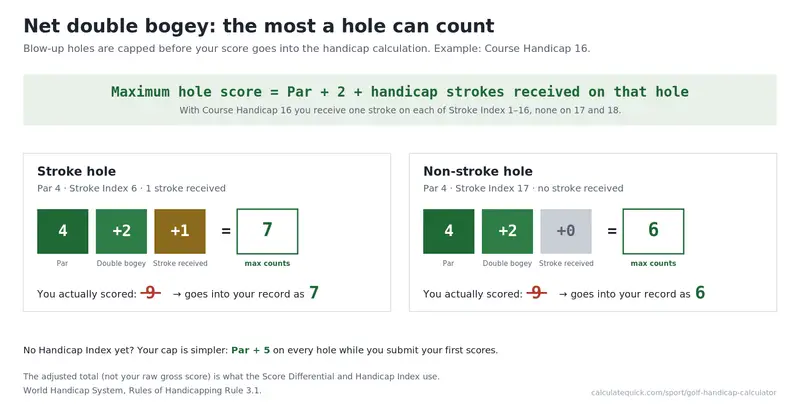
If you have an existing index, the maximum score on any hole is Net Double Bogey: Par + 2 + any handicap strokes you receive on that hole. A handicap-16 player on a par-4 stroke hole has a cap of 4 + 2 + 1 = 7. On a non-stroke hole, the cap is 4 + 2 + 0 = 6.
If you do not yet have an established index and are submitting your first scores, the cap is simpler: Par + 5 on any hole. This more generous limit accounts for the higher variability of new players while still preventing outlier holes from dominating the calculation.
Playing Conditions Calculation
PCC is a daily statistical adjustment that accounts for course conditions on the day of play – wind, rain, pin positions, course setup. Your club or national authority calculates it after the round by comparing all scores submitted that day against what was expected. PCC can range from -1 (conditions made scoring easier than normal) to +3 (conditions were significantly harder).
Most days, PCC is 0, meaning conditions were as expected. You generally do not need to worry about it unless your club provides daily PCC values, which you can then enter in the Index from Rounds tab. If you are unsure, leave PCC at 0.
Playing Handicap Allowances for Competitions
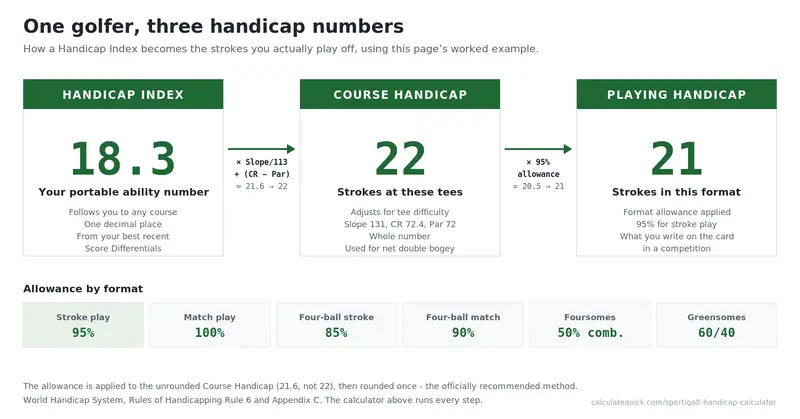
Your Course Handicap tells you how many strokes you get on the course. Your Playing Handicap adjusts that number based on the format of play. The WHS provides recommended allowances in Appendix C of the Rules of Handicapping, though committees can vary these at their discretion.
For a medium-sized individual stroke-play field of 30 to 100 players, the recommended allowance is 95% of Course Handicap. A committee may choose a different allowance—for example, 100% can be considered for a field smaller than 30.
Match play uses 100% because the format already self-corrects through the hole-by-hole nature of the game. Four-ball stroke play and Stableford drop to 85% because having two chances at each hole provides an inherent advantage. Four-ball match play uses 90%.
Team formats work differently. In Four-Ball match play, the lowest player plays off zero and the other players receive 90% of the difference from that player’s Course Handicap. Foursomes (alternate shot) takes 50% of the combined Course Handicaps of both partners. The calculator also includes the common 60%-of-lower plus 40%-of-higher convention for Greensomes/Chapman; use the allowance stated by your competition committee if it differs.
9-Hole Rounds
The WHS supports 9-hole scores. Since 2024, a posted 9-hole Score Differential is combined with an expected 9-hole differential based on the player’s current Handicap Index, producing an 18-hole Score Differential immediately. That expected-score step is completed by the official handicap service.
For a 9-hole Course Handicap, the calculator uses half the 18-hole Handicap Index rounded to one decimal place, then applies the 9-hole Course Rating, Slope Rating, and par. When the selected API tee is a rated 9, this happens automatically. Quick Estimate can show the played 9-hole differential, but only an official handicap service can add the expected-score component needed for the final 18-hole differential.
What This Calculator Does Not Cover
An official Handicap Index involves several safeguards that this calculator does not apply. Exceptional Score Reduction automatically lowers your index when you post a Score Differential 7.0 or more strokes below your current index. The Soft Cap and Hard Cap limit how quickly your index can rise – the soft cap slows increases beyond 3.0 strokes above your low index, and the hard cap prevents it from going more than 5.0 above. These mechanisms protect against rapid, unsustainable index inflation.
Committee adjustments, penalty scores, and local rules are also outside the scope of this estimator. For an official Handicap Index that includes all of these protections, register and post scores through your national golf association – USGA (United States), England Golf (England), Golf Ireland, Scottish Golf, Golf Australia, or whichever body governs handicapping in your country.
Worked Example
A golfer with a Handicap Index of 18.3 is playing the white tees at a course with a Slope Rating of 131, a Course Rating of 72.4, and a Par of 72.
Course Handicap = 18.3 x (131 / 113) + (72.4 – 72) = 18.3 x 1.159 + 0.4 = 21.2 + 0.4 = 21.6, which rounds to 22.
A simple net-par benchmark is Par + Course Handicap = 72 + 22 = 94. This is not a prediction of the golfer’s next score.
If entering a Stableford competition, the Playing Handicap is 95% of the unrounded Course Handicap: 21.6151 x 0.95 = 20.53, which rounds to 21. That means 21 strokes are distributed across holes according to the Stroke Index, with one extra stroke on the hardest 3 holes (21 strokes across 18 holes = 1 stroke each on SI 1-18, plus an extra stroke on SI 1, 2, and 3).
After the round, if the golfer’s Adjusted Gross Score is 93, the Score Differential is (113 / 131) x (93 – 72.4 – 0) = 0.863 x 20.6 = 17.8. This differential joins their scoring record and the index recalculates using the best differentials from their most recent 20 rounds.