
Calculating Golf Club Length and Lie
The adult calculator gives an iron fitting starting point. It tells you whether to order irons at the manufacturer’s standard length, longer than standard, or shorter than standard. It also gives an initial lie adjustment. These are the two specifications a club fitter or retailer will recognize.
For example, a result of ½ inch longer and 2° upright means adding half an inch to the manufacturer’s normal iron specification and starting the lie angle two degrees more upright. A result of standard-length irons means no length is added or removed. It does not mean every 7-iron made by every brand has exactly the same finished length.
| Calculator result | Meaning | What to request |
|---|---|---|
| Standard length | No length adjustment | The maker’s standard iron length |
| ½ inch longer | Add ½ inch to each standard iron | Irons built ½ inch over standard |
| ½ inch shorter | Remove ½ inch from each standard iron | Irons built ½ inch under standard |
| 2° upright | The shaft-to-sole angle starts 2° more upright | A dynamic lie check before the set is finalized |
Golf Club Length by Height and Wrist-to-Floor
- Put on the shoes you normally wear for golf.
- Stand upright on a hard, level floor. Keep your shoulders neutral and look straight ahead.
- Let both arms hang naturally. Do not reach toward the floor or pull your shoulders upward.
- Ask another person to measure vertically from the main wrist crease to the floor.
- Repeat the measurement. If the readings differ, correct your posture and measure again rather than averaging a bent or stretched position.
Enter the measurement directly into the calculator. If your tape is marked in centimeters, use the cm setting. The centimeters to inches calculator is available when you need to compare a metric measurement with an inch-based product specification.
Height alone is not enough. Two golfers of the same height can have different arm lengths, so their hands may hang at different distances from the floor. Published fitting charts use both height and wrist-to-floor as the static starting point for iron length and lie.
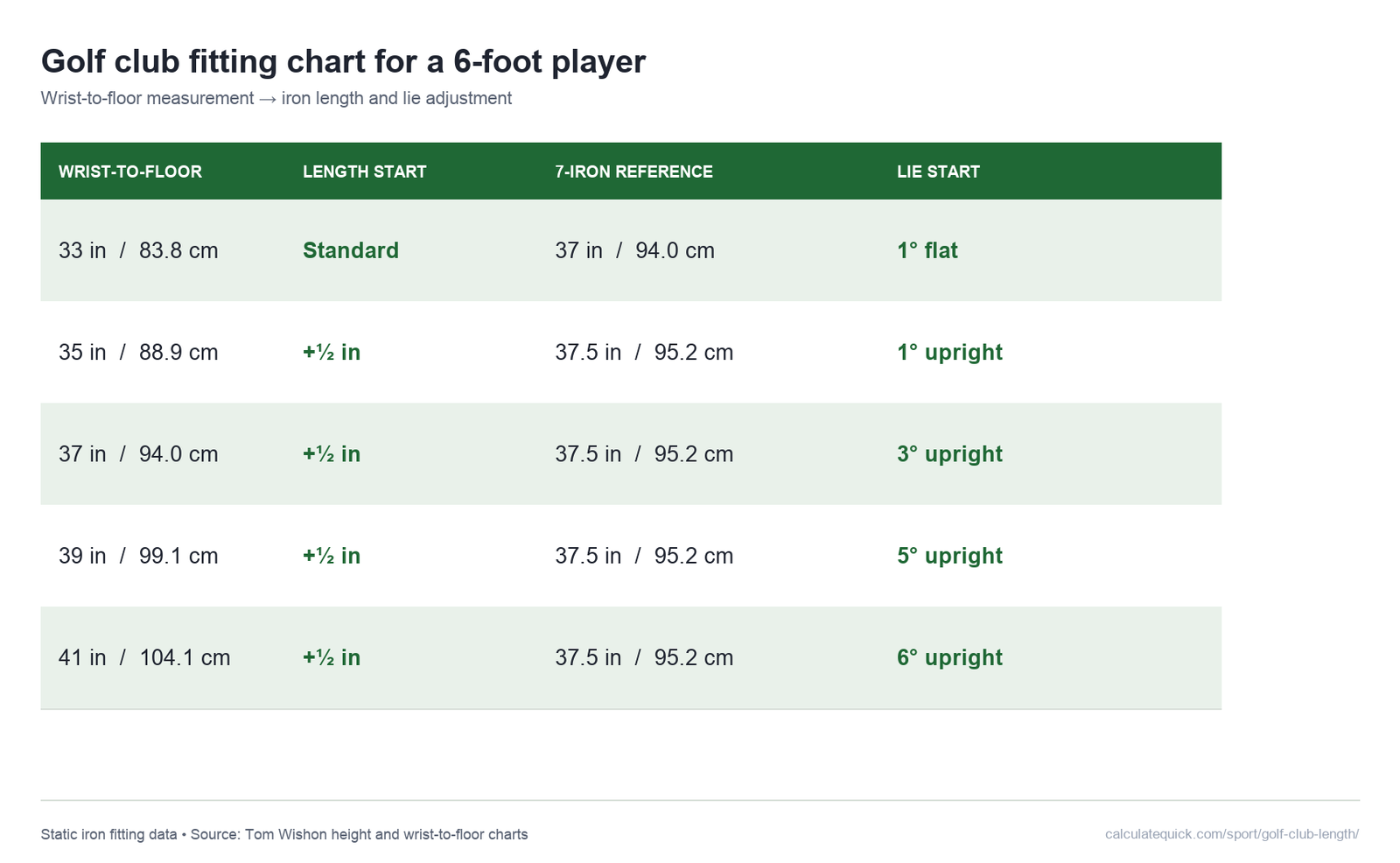
For a 6-foot golfer, the table can return standard length or ½ inch longer across the available wrist-to-floor range, while the initial lie result spans from 1° flat to 6° upright. For a 6-foot-3 golfer, the covered range starts at ½ inch longer, but the initial lie still changes from 1° flat to 5° upright. The wrist measurement remains necessary in both cases.
Golf Club Length in Inches and Centimeters
Use either unit setting for height and wrist-to-floor. The calculator converts metric measurements internally using exactly 2.54 centimeters per inch, then applies the same fitting table. It shows the reference club lengths in both units, so a metric tape does not require a separate fitting method. Manufacturer specifications may still be listed in inches, which is why the result keeps the conventional ¼-inch and ½-inch build increments visible.
Golf Club Length Chart for Adult Irons
The reference set shown by the calculator uses a 37-inch 7-iron and applies the same fitting adjustment across the iron set. It gives the recommendation a concrete scale, but it is not a universal factory chart. Check the specification page for the exact iron model before ordering or altering clubs.
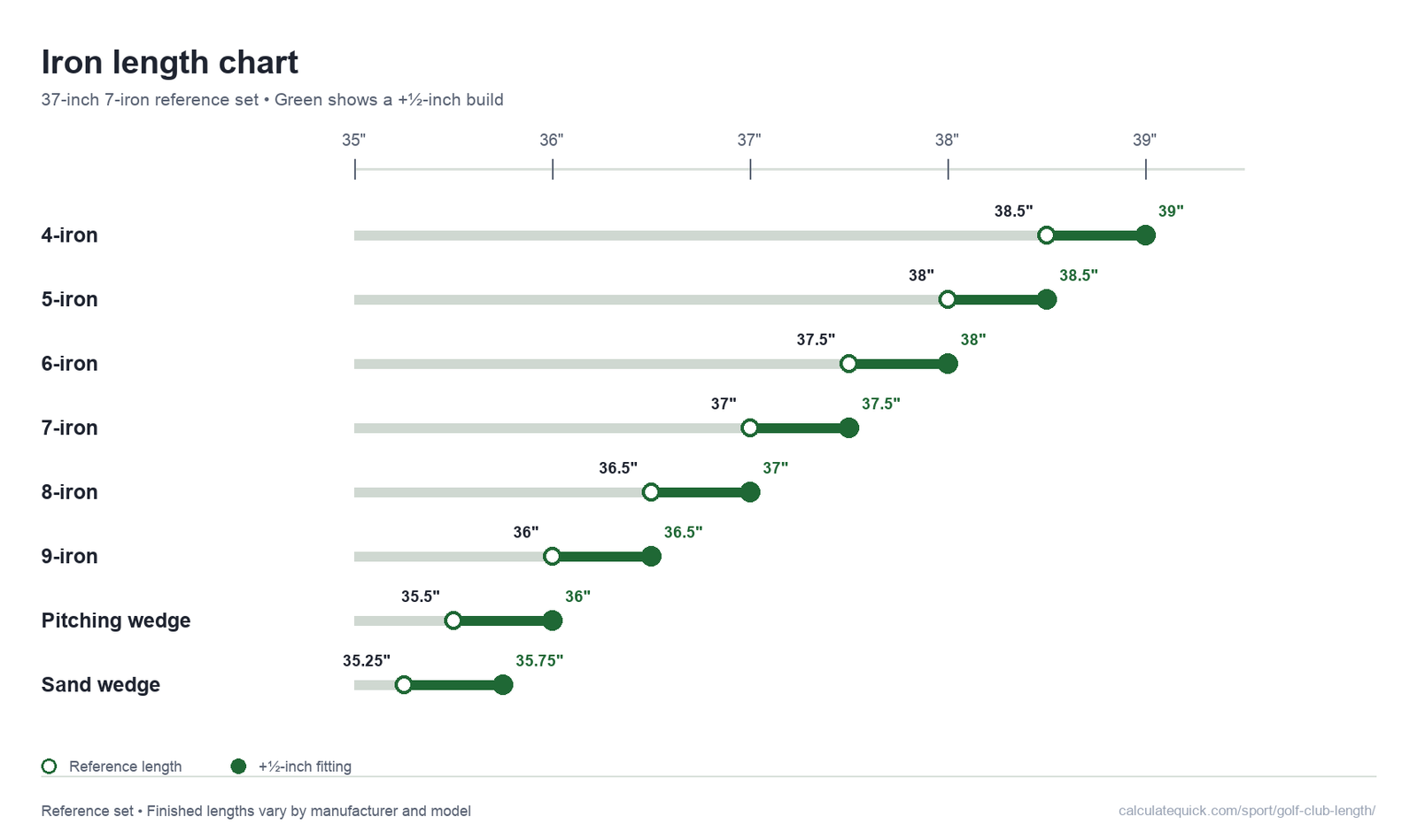
| Iron | Reference length | With a +½ inch fitting |
|---|---|---|
| 4-iron | 38½ inches | 39 inches |
| 5-iron | 38 inches | 38½ inches |
| 6-iron | 37½ inches | 38 inches |
| 7-iron | 37 inches | 37½ inches |
| 8-iron | 36½ inches | 37 inches |
| 9-iron | 36 inches | 36½ inches |
| Pitching wedge | 35½ inches | 36 inches |
| Sand wedge | 35¼ inches | 35¾ inches |
Checking Length and Lie Before Ordering
A static fit uses body measurements before the golfer hits a ball. It is useful for choosing an initial test club and avoiding an obviously unsuitable stock length. It cannot see posture at address, delivery, strike location, turf interaction, or ball flight.
During a dynamic fitting, the fitter checks the recommendation while you hit shots. Use the calculator result to narrow the first specification, then let the impact pattern and shot results confirm or change it.
Length and lie also need to be checked together. Changing shaft length changes where the hands sit, while changing lie alters how the sole meets the ground. Do not extend a full set and assume the original lie angles will remain correct.
Golf Club Length for Junior Golfers
Junior mode returns a player-height system size rather than an adult length adjustment. Current junior fitting systems use 3-inch height bands from 36 to 69 inches. Measure the player in shoes and select the band containing their current height.
| Player height | System size | Recheck point |
|---|---|---|
| 36 to under 39 inches | Size 36 | 39 inches |
| 39 to under 42 inches | Size 39 | 42 inches |
| 42 to under 45 inches | Size 42 | 45 inches |
| 45 to under 48 inches | Size 45 | 48 inches |
| 48 to under 51 inches | Size 48 | 51 inches |
| 51 to under 54 inches | Size 51 | 54 inches |
| 54 to under 57 inches | Size 54 | 57 inches |
| 57 to under 60 inches | Size 57 | 60 inches |
| 60 to under 63 inches | Size 60 | 63 inches |
| 63 to under 66 inches | Size 63 | 66 inches |
| 66 to under 69 inches | Size 66 | Compare with adult fitting |
Do not buy a substantially longer set for a child to grow into. Junior systems also change head weight, shaft weight, flex, and grip size. Separate hand length and breadth measurements can help when comparing grip options, but the junior maker’s own grip chart still takes priority. A cut-down adult club is not automatically equivalent to a properly sized junior club.
A search for club length for a 10-year-old does not have one safe numerical answer. Children of the same age can differ substantially in height, and junior systems are sold by player-height bands. Measure the child in the shoes they will play in, then use Junior sets mode rather than choosing from age alone.
Drivers, Fairway Woods, and Putters Need Separate Fits
The calculator deliberately does not apply the iron adjustment to the driver, fairway woods, or putter. Those clubs have different jobs and different fitting constraints. Driver length is strongly affected by center contact and face control. Putter length depends on setup, eye position, arm hang, and stroke. Fit them separately rather than adding the iron adjustment across the whole bag.
Once the clubs are fitted and in play, the golf handicap calculator can calculate a Handicap Index from score differentials and course data.


