Recent Conversions
Calculating Grams to Cups for Any Ingredient
Pick your ingredient, type a weight in grams, and the converter returns the volume in cups. Type in the cups field instead and it converts back to grams. The fraction line under the cups result translates the decimal into the nearest kitchen measure, so 0.74 cups reads as roughly ¾ cup and you can reach straight for the right measuring cup.
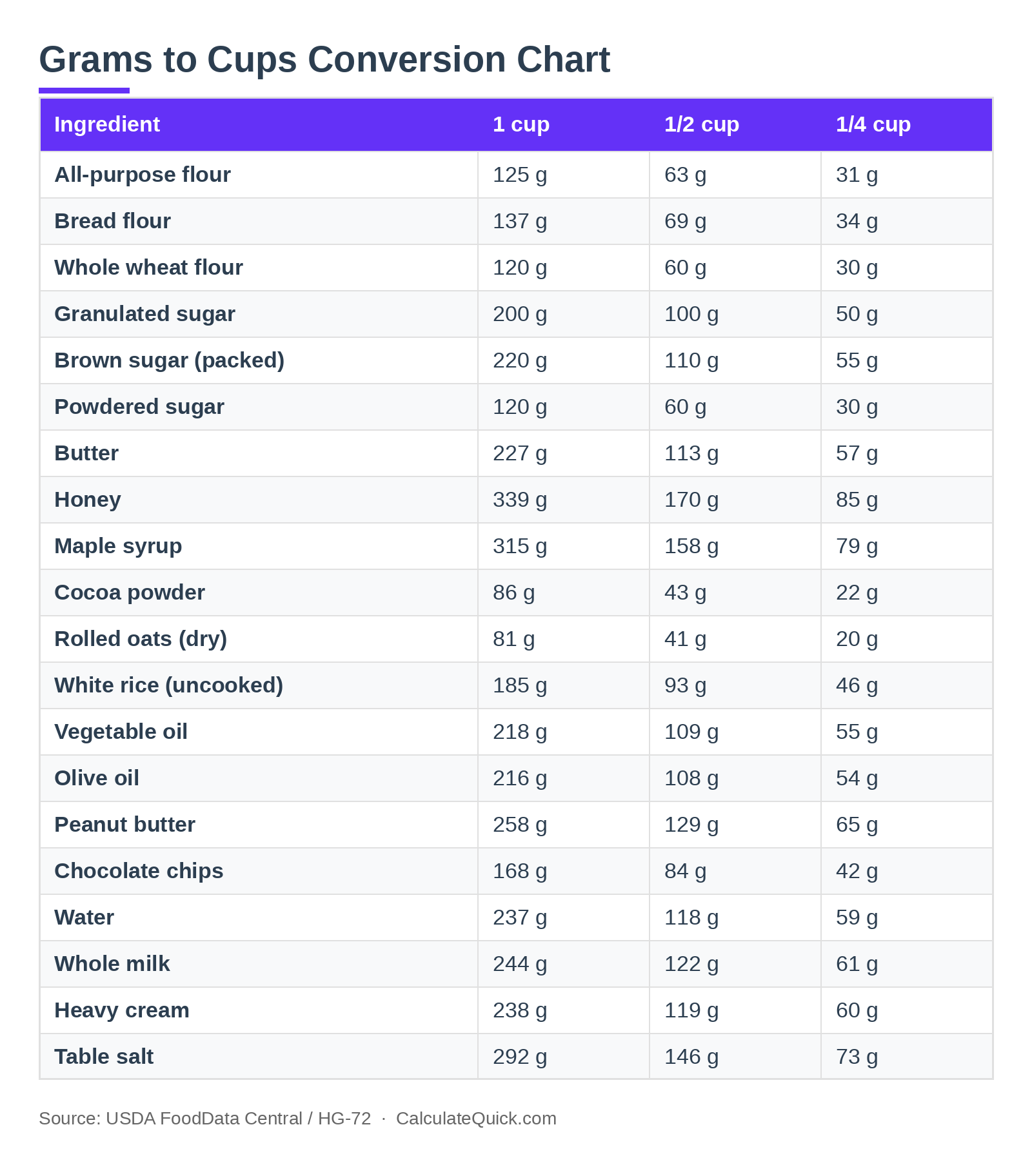
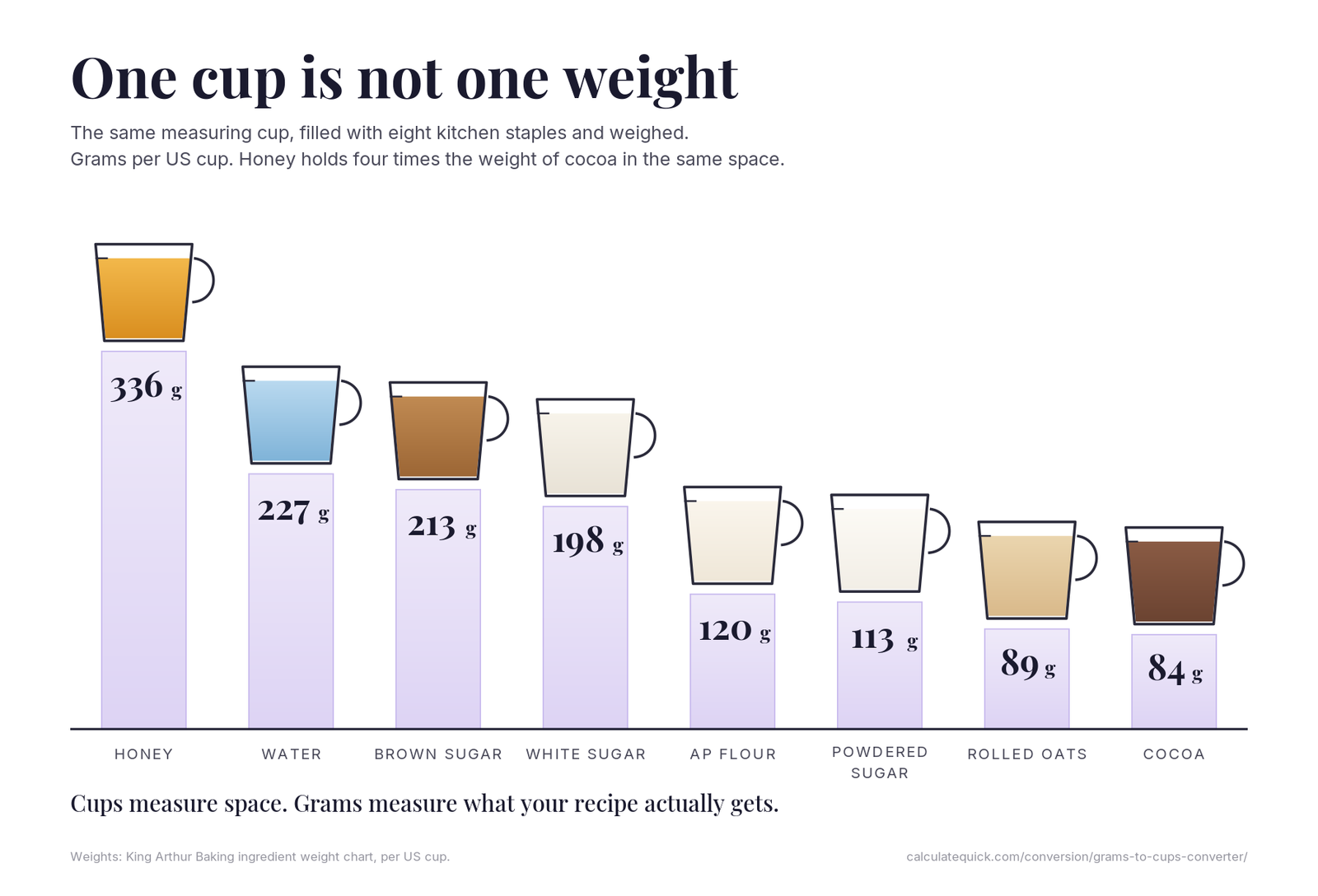
The ingredient selector is the part that does the real work. A cup is a fixed volume, but a gram is a unit of weight, so the answer changes with how dense the ingredient is. One cup of all-purpose flour weighs 125 grams while the same cup filled with honey weighs 339 grams. A recipe that lists 200 grams means almost exactly 1 cup if it is sugar and about 1⅔ cups if it is flour. Generic converters that use one fixed ratio get every dry ingredient wrong, which is why this grams to cups conversion calculator is built on per-ingredient densities from the USDA’s FoodData Central and Home and Garden Bulletin 72.
| Ingredient | 1 cup | ½ cup | ¼ cup |
|---|---|---|---|
| All-purpose flour | 125 g | 63 g | 31 g |
| Bread flour | 137 g | 69 g | 34 g |
| Whole wheat flour | 120 g | 60 g | 30 g |
| Granulated sugar | 200 g | 100 g | 50 g |
| Brown sugar (packed) | 220 g | 110 g | 55 g |
| Powdered sugar (unsifted) | 120 g | 60 g | 30 g |
| Butter | 227 g | 113 g | 57 g |
| Honey | 339 g | 170 g | 85 g |
| Maple syrup | 315 g | 158 g | 79 g |
| Cocoa powder | 86 g | 43 g | 22 g |
| Rolled oats (dry) | 81 g | 41 g | 20 g |
| White rice (uncooked) | 185 g | 93 g | 46 g |
| Vegetable oil | 218 g | 109 g | 55 g |
| Olive oil | 216 g | 108 g | 54 g |
| Peanut butter | 258 g | 129 g | 65 g |
| Chocolate chips | 168 g | 84 g | 42 g |
| Water | 237 g | 118 g | 59 g |
| Whole milk | 244 g | 122 g | 61 g |
| Heavy cream | 238 g | 119 g | 60 g |
| Table salt | 292 g | 146 g | 73 g |
Cups Measure Volume, Grams Measure Weight
A measuring cup holds the same amount of space no matter what you put in it. What changes is how much that space weighs. Flour is full of air pockets, so a cup of it is light. Honey and maple syrup are dense liquids, so the same cup weighs nearly three times as much. That single fact explains every number in the table above, and it is the same weight-to-volume logic behind converting milligram doses to milliliters in medicine.
It also explains a common recipe trap. Ounces on American packaging can mean weight ounces or fluid ounces, and they are not interchangeable. If your recipe lists dry ounces, convert grams to ounces by weight. If it lists fluid ounces for a liquid, use the fluid ounces to cups conversion instead, where 8 fl oz always equals 1 cup regardless of the ingredient.
Note that packing changes the numbers for some ingredients. Brown sugar is conventionally measured packed, pressed firmly into the cup, which is how the 220 g figure is defined. Powdered sugar is measured unsifted and spooned at 120 g. If you sift first, a cup holds closer to 100 g. The converter follows the standard USDA conventions for each ingredient, which match how American recipes are written.
Grams to Cups Tables for Flour, Sugar, and Butter
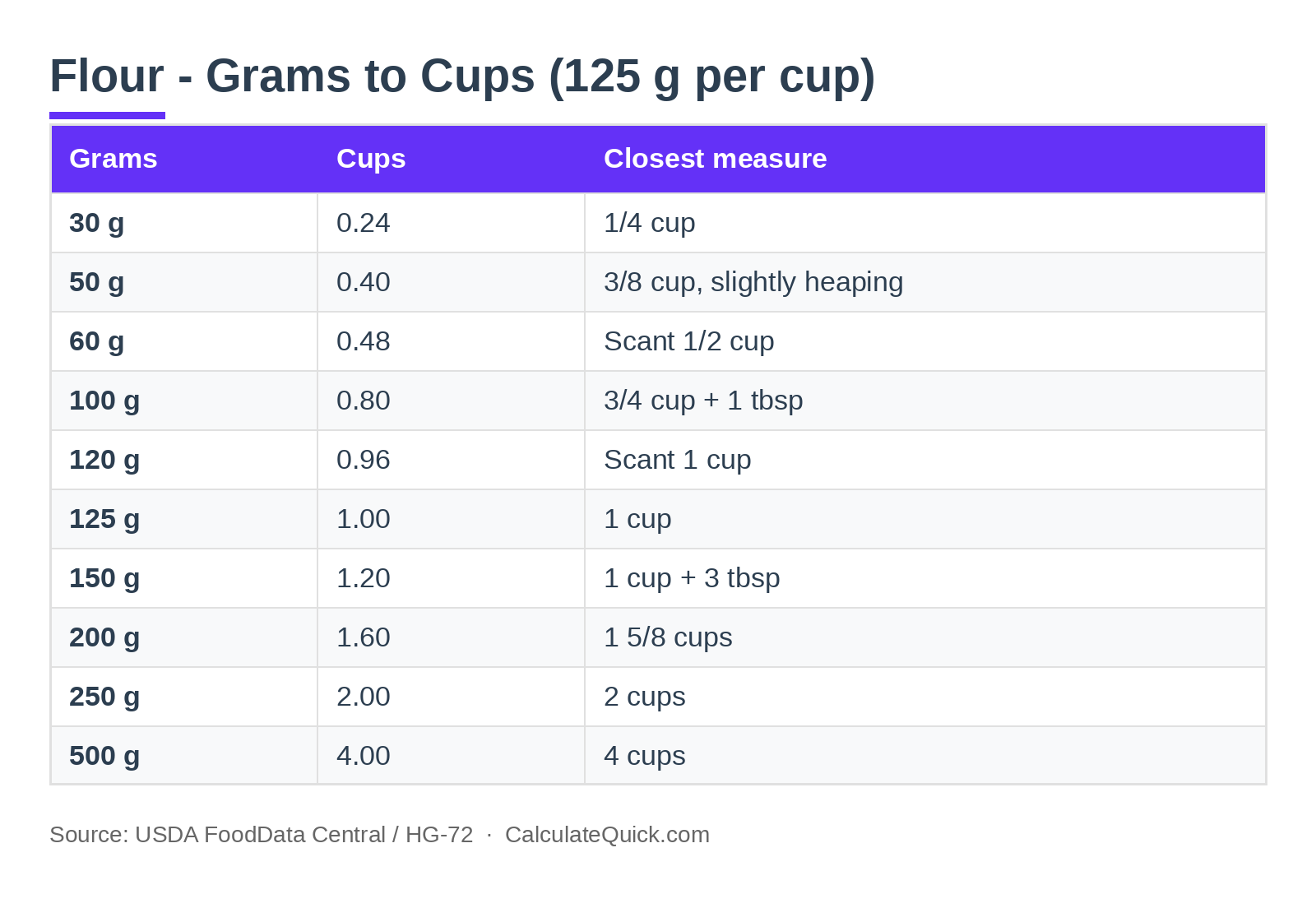
These three ingredients account for most conversion lookups. The flour table uses the USDA standard of 125 g per cup for all-purpose flour, spooned into the cup and leveled.
| All-Purpose Flour | Cups (decimal) | Closest measure |
|---|---|---|
| 30 g | 0.24 | ¼ cup |
| 50 g | 0.40 | ⅜ cup, slightly heaping |
| 60 g | 0.48 | Scant ½ cup |
| 100 g | 0.80 | ¾ cup + 1 tbsp |
| 120 g | 0.96 | Scant 1 cup |
| 125 g | 1.00 | 1 cup |
| 150 g | 1.20 | 1 cup + 3 tbsp |
| 200 g | 1.60 | 1⅝ cups |
| 250 g | 2.00 | 2 cups |
| 500 g | 4.00 | 4 cups |
| Granulated Sugar | Cups |
|---|---|
| 50 g | ¼ cup |
| 100 g | ½ cup |
| 150 g | ¾ cup |
| 200 g | 1 cup |
| 250 g | 1¼ cups |
| 300 g | 1½ cups |
| 400 g | 2 cups |
| 500 g | 2½ cups |
| Butter | Cups | Sticks |
|---|---|---|
| 28 g | ⅛ cup (2 tbsp) | ¼ stick |
| 57 g | ¼ cup | ½ stick |
| 113 g | ½ cup | 1 stick |
| 170 g | ¾ cup | 1½ sticks |
| 227 g | 1 cup | 2 sticks |
| 454 g (1 lb) | 2 cups | 4 sticks |
Measuring Flour Accurately Without a Scale
The 125 g standard assumes you spoon flour into the cup and level it off with a straight edge. Dragging the cup through the flour bag instead compresses the flour and can pack 150 g or more into the same cup, a 20 percent overshoot that turns tender cookies dense and cakes dry. If your bakes keep coming out heavy, this is the most likely culprit.
To measure flour by volume properly, fluff the flour in its container first, spoon it loosely into the measuring cup without tapping or shaking, then sweep the excess off with the back of a knife. Done this way, a cup of all-purpose flour lands within a few grams of the USDA figure. Better still, weigh it. A digital scale removes the technique problem entirely, which is why serious baking recipes list grams in the first place.
US Cups, Metric Cups, and UK Measures
This calculator uses the US customary cup of 236.59 mL, the one molded into American measuring cup sets. Australia, New Zealand, and most metric-country cookbooks use a 250 mL metric cup, about 6 percent larger. US nutrition labels round to a 240 mL legal cup. The differences are small for a single cup but compound in large batches, so check which cup your recipe’s author means. British recipes rarely use cups at all and lean on weights or imperial pints, and older UK recipes may reference imperial fluid ounces, which differ slightly from the US version covered in our milliliters to fluid ounces conversion.
Converting a Whole Recipe at Once
Converting ingredient by ingredient works for one or two lines, but a full European recipe in grams is faster to handle in bulk. Convert each dry ingredient here, keep liquids in milliliters where your measuring jug already shows them, and if you also need to halve or double the quantities, the recipe conversion calculator scales every line in one pass. For bulk amounts, like a 2 kg bag of flour, converting kilograms to pounds first makes American package sizes easier to compare.
One habit worth stealing from professional bakers when you convert in either direction is to write the converted recipe down once and keep it. Repeated conversion is where rounding errors creep in. Convert from the original gram amounts each time rather than from a previously converted cup amount, and round only at the final step.