
See what your fabric becomes as kaleidoscope hexagons before you cut a single piece. Use the demo fabric or upload your own busy, large-scale print, set your triangle size, then generate, arrange, and save your design.
Fabric estimate (how much to buy)
Estimate only, for blocks. A One Block Wonder needs identical repeats stacked (usually 6) so every triangle in a hexagon matches. Always verify you have the full number of complete repeats, and buy extra fabric separately for borders, binding, sashing and backing. Do not pre-wash.
Using the One Block Wonder Calculator
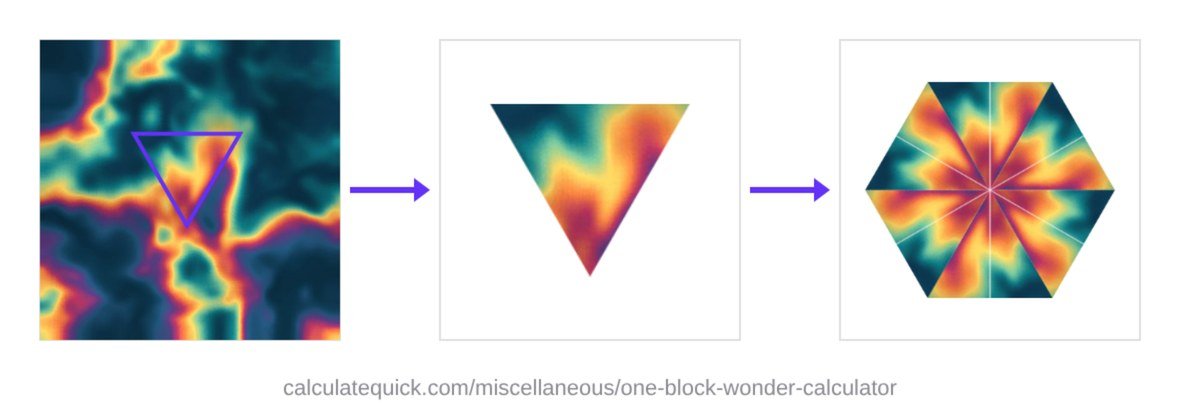
Load the demo fabric or upload a photo of your own print, then set two numbers: the real width of the fabric shown in the image and the triangle edge length you want to cut. The tool draws the 60 degree cutting grid straight onto the fabric so you can see where every triangle falls. Click the fabric, or drag the start sliders, to shift the grid until the triangles land on the part of the print you like, then press Make hexagons.
Each hexagon is one triangle copied six times around a centre point, which is exactly what happens when you stitch six identical triangles together. Drag the hexagons to rearrange them, double click one to spin it to a different centre, and use the colour or value sort to group them before you settle on a layout. Save keeps your arrangement in the browser so it survives a page reload, and Export PNG gives you an image to take to the cutting table.
Picking a Fabric That Makes Good Hexagons
The kaleidoscope effect comes from variety inside a single triangle, so the busiest, most multicoloured prints give the most striking results. Large-scale florals, paisleys, batiks and swirling marbled prints all work well, and six or more colours with plenty of curved lines give each hexagon something to play with.
Steer away from prints with large flat areas of one colour, a single big motif on a plain ground, evenly spaced spots or tight geometric grids, and directional stripes or plaids. Those either repeat into something flat or fight the six-way symmetry. If your fabric is measured in centimetres, the centimetres to inches converter turns the repeat length into the inches this calculator expects.
Calculating How Much Fabric to Buy
A One Block Wonder is cut from six identical repeats of the same fabric, stacked so every triangle in a hexagon matches. To find one repeat, lay the fabric out, pick an easy to spot element near the selvage, and measure to where it appears again. Buy six of those repeats for the blocks. A 24 inch repeat needs 6 x 24 = 144 inches, which is 4 yards, and most teachers suggest buying about a quarter yard extra and confirming you have six complete repeats before you cut.
Panel prints work differently: buy seven panels, six for the repeats and a seventh to build the design around. Borders, sashing, binding and backing are all separate from the block fabric, so add those amounts on top. One habit worth keeping is to leave the fabric unwashed, since the layers need to sit together cleanly for stacking and cutting.
Triangle and Hexagon Sizes
The calculator cuts equilateral triangles, so the strip you cut is as wide as the triangle is tall. A 3.75 inch strip is a common starting point. The triangle edge runs a little longer than the strip width, and once six triangles are joined with quarter inch seams the finished hexagon ends up smaller than the raw pieces. The sizes under the inputs update as you change the triangle edge, and the table below shows a few common edges with their cut height and rough finished width.
| Cut triangle edge | Cut triangle height | Finished hexagon, point to point |
|---|---|---|
| 3.5 in | 3.0 in | about 5.3 in |
| 4.0 in | 3.5 in | about 6.3 in |
| 5.0 in | 4.3 in | about 8.3 in |
Six equilateral triangles meeting at a point form a regular hexagon, the same geometry behind any six-sided figure. If you want to dig into how those side and width measurements relate, the circumference calculator works through the equivalent relationships for circles.
Sewing the Quilt Top
Stack your six repeats with the motifs lined up, cut strips across the width of the fabric, then cut 60 degree triangles from the strips. Keep each set of six matching triangles together, because each set becomes one hexagon. Sew the six triangles into two half hexagons, join the halves, and press the seams. Lay the finished hexagons on a design wall, move them until the colours flow, then number and pin each row before you sew the rows together so the order holds while you work.