About Your Beef
On the processor’s invoice. Leave empty to use a typical 850 lb whole carcass.
Your Freezer
Your Results
Take-home beef
Freezer space needed
Lasts about
Freezer Size
Calculating Freezer Space for a Beef Share
The calculator starts from the hanging weight, the carcass weight your farm or processor charges on. Only part of it comes home in packages, because bone, fat and trim stay at the butcher. Washington State University Extension puts take-home meat at about 55-60% of the hanging weight for mostly bone-in cuts and 50-55% when more of the carcass is boned out or ground. The calculator uses the middle of those ranges: 57.5%, 55% for a typical mix, and 52.5%.
Freezer space follows from the take-home weight. Oklahoma State, Mississippi State and Washington State extension services all use the same rule of thumb: one cubic foot of freezer space holds 35-40 lb of cut and wrapped meat, and odd shapes take a little more room. The calculator uses 35 lb per cubic foot for mostly bone-in cuts, 38 for a typical mix and 40 for mostly boneless, then rounds the space up so the answer is never too small.
If you leave the hanging weight empty, the calculator assumes an 850 lb whole carcass, the middle of the 750-950 lb range WSU gives for market steers, and shares it out by portion. The figure on your invoice is better. Cattle have grown heavier: fed steer carcasses averaged a record 983 lb in early November 2025. If your processor quotes kilograms, convert the hanging weight from kilograms to pounds before you enter it.
Typical Weights and Freezer Space by Portion
Mixed cuts from an 850 lb carcass, packed at 38 lb per cubic foot:
| Portion | Hanging weight | Take-home beef | Freezer space |
|---|---|---|---|
| Whole cow | 850 lb | 468 lb | 12.4 cu ft |
| Half cow | 425 lb | 234 lb | 6.2 cu ft |
| Quarter cow | 213 lb | 117 lb | 3.1 cu ft |
| Eighth cow | 106 lb | 58 lb | 1.6 cu ft |
A half from a 983 lb carcass comes to about 270 lb of take-home beef and 7.2 cu ft of freezer space, which is why the invoice weight is worth entering.
Bone-In and Boneless Cuts
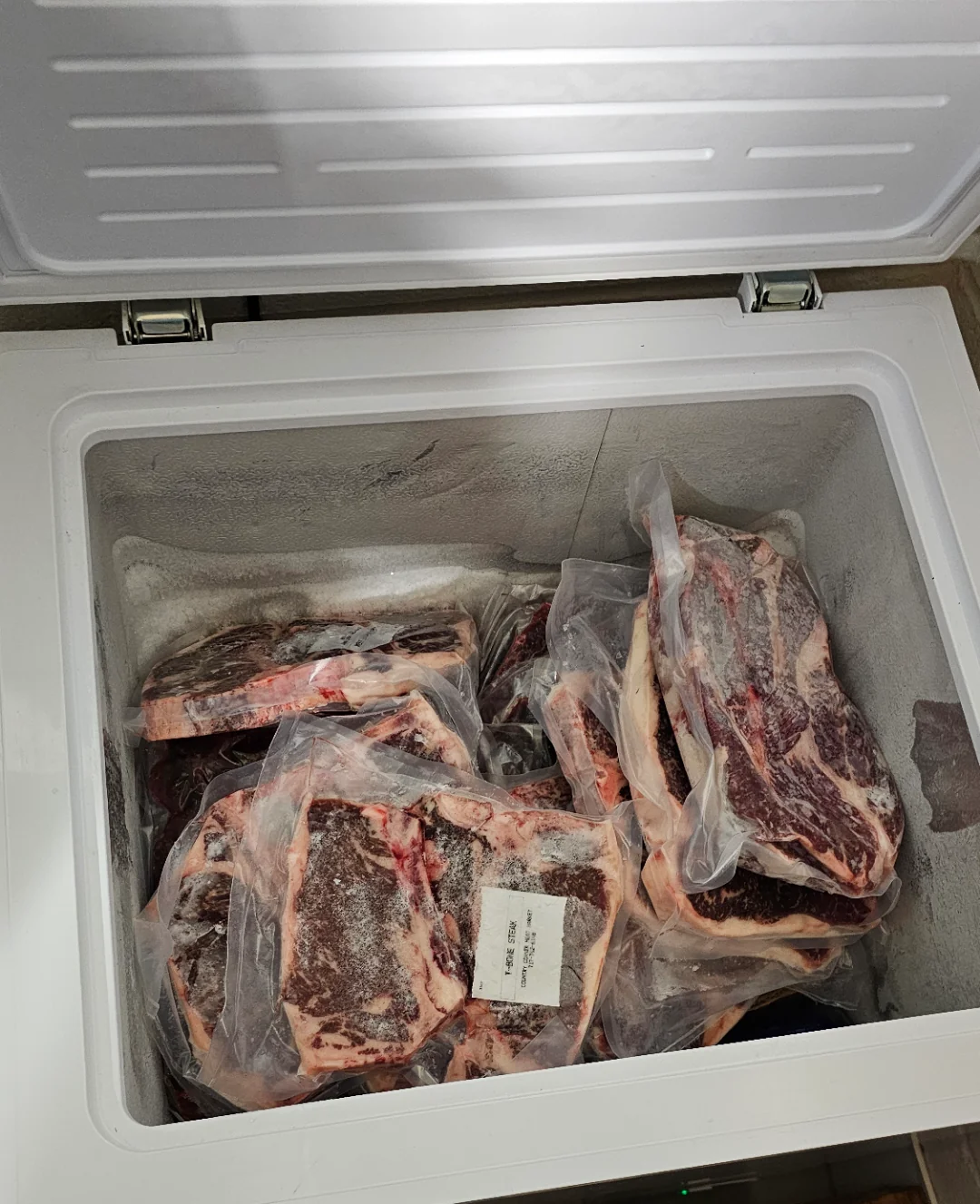
Asking for more boneless cuts changes two numbers. You take home fewer pounds, because the bone stays at the processor, and the pounds you do take home pack more tightly. For a quarter of an 850 lb carcass, mostly bone-in cuts come to about 122 lb needing 3.5 cu ft, while mostly boneless cuts come to about 112 lb needing 2.8 cu ft.
It is the same edible meat either way; boneless only means the bone comes out before wrapping instead of at your stove. To compare offers from different farms, work out what percentage of the hanging weight came home on your last order.
Vacuum-Sealed or Butcher Paper
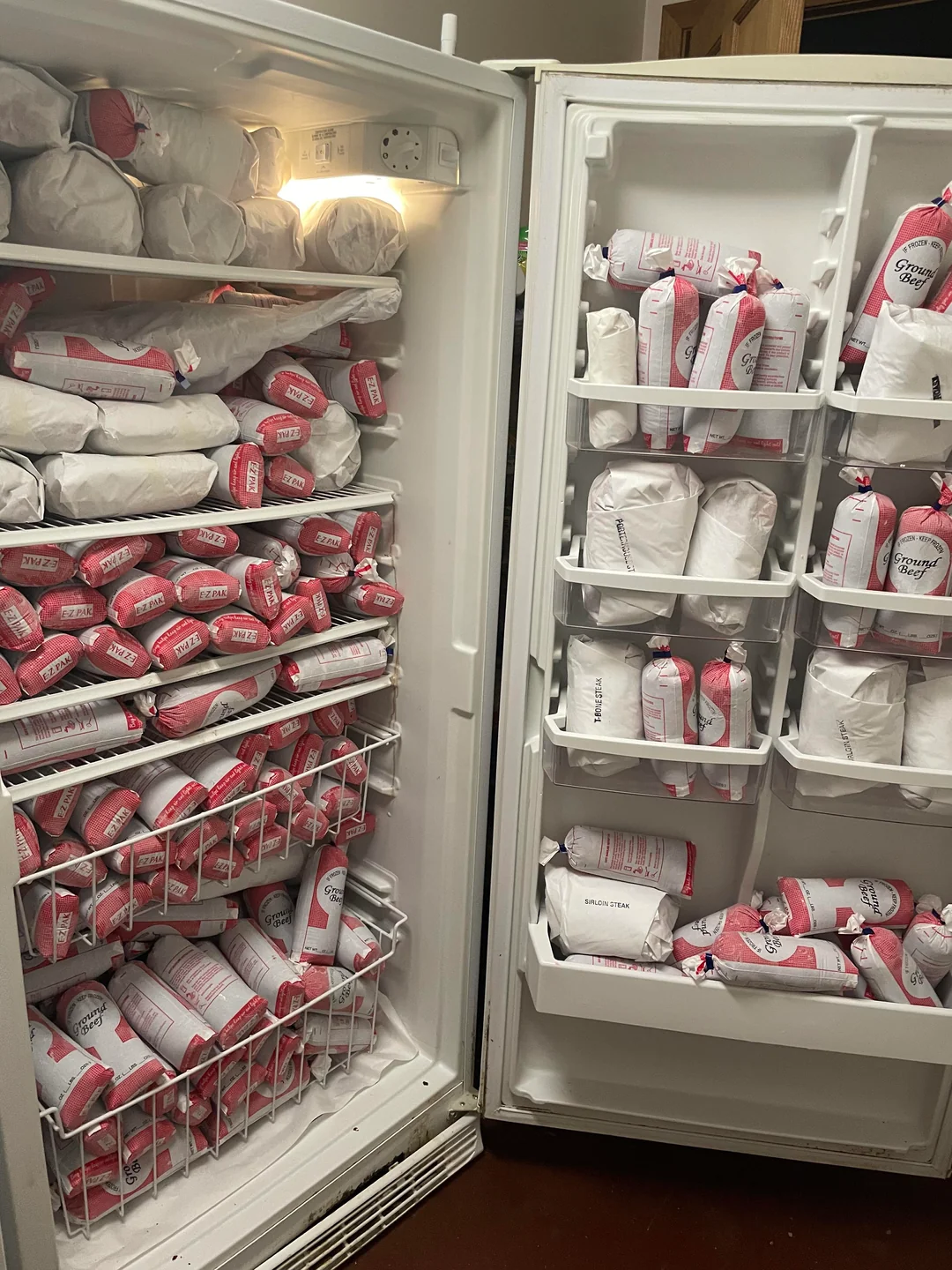
The extension guides give the same 35-40 lb per cubic foot for cut and wrapped meat and publish no separate figure for vacuum-sealed packs, so the calculator treats both the same. Clemson Cooperative Extension notes that vacuum packing removes more air and can save space. Flat vacuum packs stack more neatly than paper bundles, so if your beef comes in bulky, irregular paper packages, choose the larger freezer size the calculator suggests.
Either wrapping keeps beef well as long as it is moisture- and vapor-resistant and sealed. Rewrap any torn packages before they go in.
Chest, Upright or Fridge Freezer
- Chest freezer. Cheaper to buy and run, and it loses less cold air when opened, according to Clemson Cooperative Extension. Sliding or lift-out baskets stop cuts from getting buried at the bottom.
- Upright freezer. Takes less floor space and has three to seven shelves, so cuts are easy to find. Shelves and door bins use part of the rated capacity, so pick the larger of the two sizes the calculator gives.
- Fridge freezer. Fine for an eighth if you can clear the space. It also holds your everyday frozen food, and it should keep 0°F or colder.
Months of Beef by Household Size
USDA’s Economic Research Service estimates about 58.5 lb of beef available per person in 2025, and the calculator uses that figure for how long a share lasts. Mixed cuts from an 850 lb carcass:
| Household | Eighth | Quarter | Half | Whole |
|---|---|---|---|---|
| 1 person | 12 months | 24 months | 48 months | 96 months |
| 2 people | 6 months | 12 months | 24 months | 48 months |
| 4 people | 3 months | 6 months | 12 months | 24 months |
| 6 people | 2 months | 4 months | 8 months | 16 months |
Oklahoma State University Extension suggests using frozen beef within 9-12 months and ground beef within 3-4 months for the best quality, and deciding before you buy whether your household can eat the beef within a year. If your result runs well past 12 months, a smaller portion or a share split with another household keeps more of it at its best.
Keeping a Full Freezer Organized
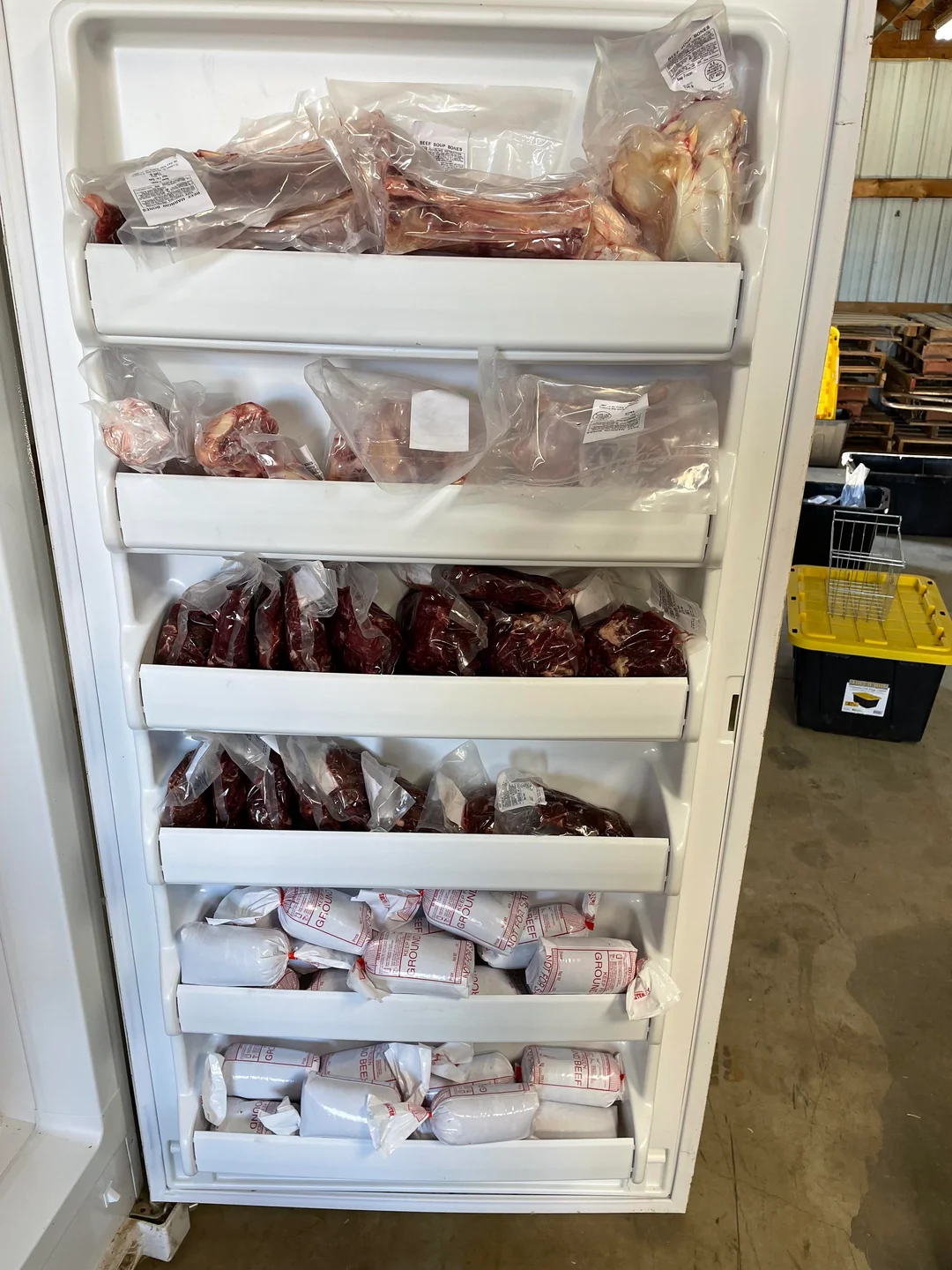
- Group cuts in bins or boxes: ground beef, steaks, roasts, and bones or soup cuts.
- Keep an inventory list on the lid or door and cross items off as you use them.
- Put ground beef, the cut you will reach for most, where you can get at it without unpacking.
- Stand steaks upright in a bin, like files in a drawer, so you can read every label.
- Label each package with the cut and the date, and keep the freezer at 0°F or colder.
Packages are cut to a fixed size, so a pound of ground beef rarely matches a recipe written for four. Scaling a recipe to use a whole package saves opening a second one.
Questions Before You Order
What if the power goes out?
Keep the door closed. FoodSafety.gov says a full freezer holds a safe temperature for about 48 hours and a half-full one for about 24 hours. Beef that still has ice crystals, or is at 40°F or below, can be refrozen, though its quality may suffer.
Can I split a cow with friends?
Yes. Many farms sell halves and quarters, and households often share a whole or a half. Agree before the cut sheet goes in how the steaks, roasts and ground beef will be divided, then run the calculator for your own share’s hanging weight, not the whole carcass.
Where can I buy a share of beef?
Local farms that sell direct, farmers markets and meat shares are the usual routes. Order early: WSU Extension notes that harvest dates are getting harder to secure because there are fewer local butchers, so confirm the processing date before you pay for the animal, and have your freezer space ready before pickup.