Stamp Duty Land Tax Calculator
Calculate exactly how much Stamp Duty you’ll pay on property purchases in England and Northern Ireland. Up to date for 2025/26: these rates took effect on 1 April 2025 and still apply.
1. Select Property Type
2. Select Buyer Type
3. Enter Property Price
Enter your details and press ‘Calculate’ to see your Stamp Duty cost
Important Note
Stamp Duty Land Tax (SDLT) must be paid within 14 days of completion. This calculator reflects rates for England and Northern Ireland as of April 2025. Different taxes apply in Scotland (LBTT) and Wales (LTT).
Calculating Stamp Duty for 2025/26
Pick the property type, choose your buyer category, enter the purchase price, and the calculator returns the total Stamp Duty Land Tax due along with the effective tax rate and a band-by-band breakdown. The comparison toggle shows what the same purchase would have cost under the pre-April 2025 thresholds, so you can see exactly how the rate change affects your transaction.
The buyer category changes the answer more than most people expect. A £450,000 home costs a first-time buyer £7,500 in stamp duty, a home mover £11,250, and a second-home buyer £33,750. Run the numbers before you make an offer, and if you are working backward from a fixed budget, the maximum allowable offer calculator tells you the highest bid you can make once stamp duty and fees are accounted for.
SDLT applies only in England and Northern Ireland. Scotland and Wales run their own property transaction taxes with different bands and deadlines, covered in the regional comparison further down.
Current SDLT Rates
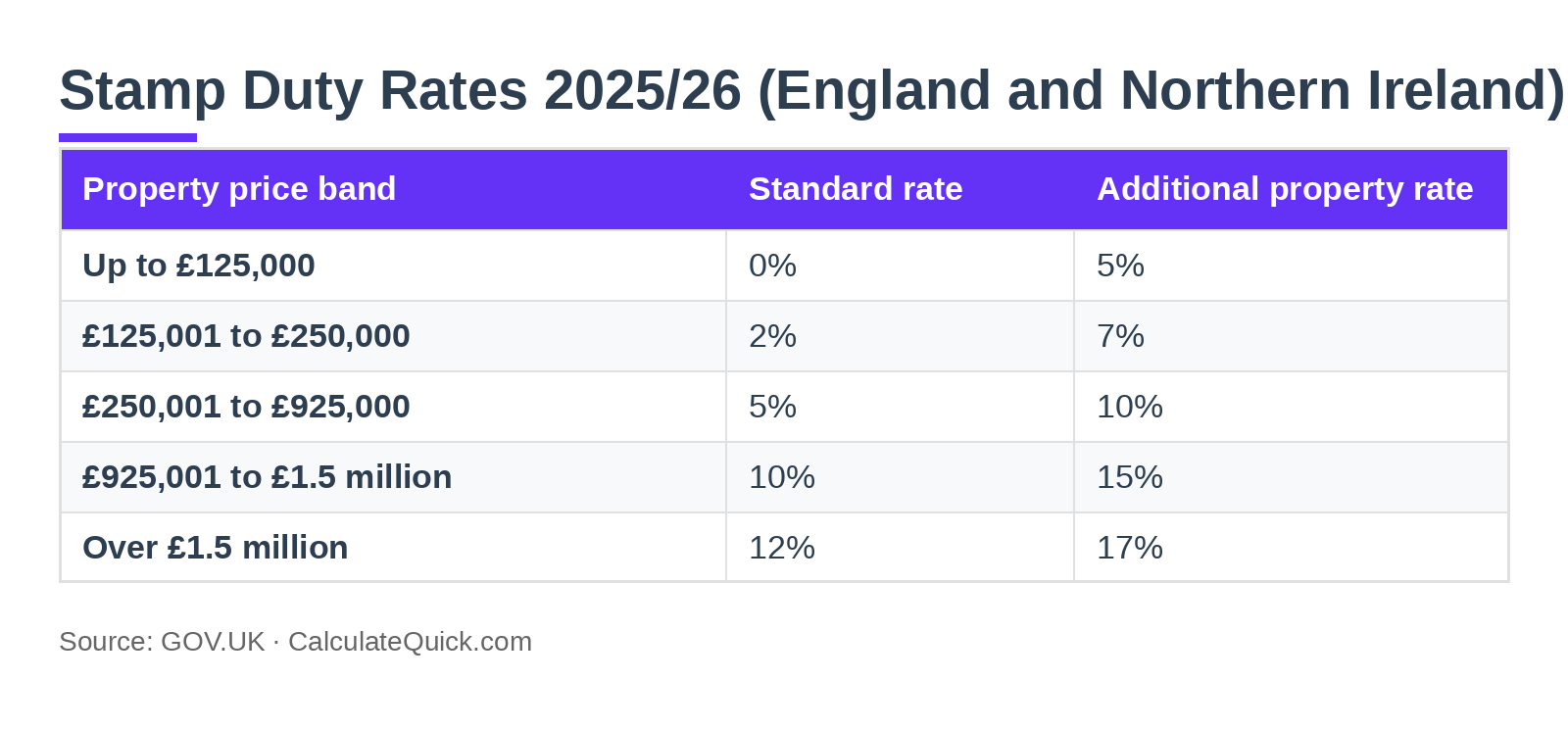
These rates have been in force since 1 April 2025. SDLT is a progressive tax, so each rate applies only to the slice of the price that falls inside its band, not to the whole purchase price.
| Property price band | Standard rate | Additional property rate |
|---|---|---|
| Up to £125,000 | 0% | 5% |
| £125,001 to £250,000 | 2% | 7% |
| £250,001 to £925,000 | 5% | 10% |
| £925,001 to £1,500,000 | 10% | 15% |
| Over £1,500,000 | 12% | 17% |
Non-UK residents pay a further 2% on top of whichever column applies to them, per the GOV.UK non-UK resident rates.
Non-residential and mixed-use purchases use a separate, lower set of bands. A mixed-use property, such as a shop with a flat above it, qualifies for these rates even though part of it is residential.
| Property price band | Non-residential rate |
|---|---|
| Up to £150,000 | 0% |
| £150,001 to £250,000 | 2% |
| Over £250,000 | 5% |
Worked Example on a £400,000 Purchase
A home mover buying a £400,000 house pays nothing on the first £125,000, 2% on the next £125,000, and 5% on the remaining £150,000.
| Portion of price | Rate | Tax |
|---|---|---|
| First £125,000 | 0% | £0 |
| £125,001 to £250,000 | 2% | £2,500 |
| £250,001 to £400,000 | 5% | £7,500 |
| Total SDLT | £10,000 |
That works out to an effective rate of 2.5%, well below the 5% headline rate of the top band reached. The calculator shows this same breakdown for any price you enter.
Recent Rate Changes
On 1 April 2025 the nil-rate band for standard residential purchases dropped from £250,000 back to £125,000, and the first-time buyer relief threshold returned to £300,000 from a temporary £425,000. The additional property surcharge had already risen from 3% to 5% in October 2024. Together these changes added £2,500 to the bill on a typical standard purchase above £250,000.
Buyer Categories
First-Time Buyers
First-time buyers pay no SDLT on the first £300,000 of the purchase and 5% on the portion from £300,001 to £500,000. The relief is worth up to £5,000 compared with standard rates. If the property costs more than £500,000, the relief disappears entirely and standard rates apply to the whole price, per the HMRC first-time buyer relief guidance.
To qualify, you must never have owned residential property anywhere in the world, whether bought or inherited, and you must intend to live in the property as your main residence. On a joint purchase, every buyer has to meet the test. One previous owner on the mortgage means no relief for anyone.
Additional Property Buyers
Buying a second home or buy-to-let adds a 5% surcharge to every band, which is 5% of the full purchase price on top of the standard bill. On a £250,000 buy-to-let that means £15,000 instead of £2,500. The surcharge applies whenever you will own more than one property at the end of the transaction day. Factor it in before relying on rental income to carry the purchase, and check the deal still stacks up with the rental yield calculator.
If you are replacing your main residence but have not yet sold the old one, you pay the higher rates up front and can claim the surcharge back if the previous main home sells within 36 months. The refund claim must go in within 12 months of that sale or within 12 months of the filing date for the new purchase, whichever is later.
Non-UK Residents
Buyers who spent fewer than 183 days in the UK in the 12 months before purchase pay a 2% surcharge on residential property, stacked on top of any other rates that apply. The surcharge is refundable if you then spend 183 or more days in the UK within the 24 months around the purchase. It applies to overseas companies as well as individuals.
Corporate Buyers
Companies buying residential property automatically pay the additional property rates with the 5% surcharge. A property over £500,000 bought for personal use attracts a flat 17% on the entire price instead. Qualifying business use, such as rental or development, earns relief from the flat rate but keeps the 5% surcharge, per the GOV.UK corporate bodies guidance. Companies holding residential property over £500,000 may also owe Annual Tax on Enveloped Dwellings (ATED) in later years.
Payment and Filing
The SDLT return must be filed and the tax paid within 14 days of completion. Miss the deadline and HMRC charges £100 for returns up to 3 months late and £200 after that, with interest on unpaid tax on top.
In practice your solicitor or conveyancer handles this. They complete and submit the return, collect the tax from you before completion, pay HMRC directly, and give you confirmation of payment. If you are handling the purchase yourself, you can file and pay online through the HMRC website.
Regional Differences
SDLT covers England and Northern Ireland only. Scotland charges Land and Buildings Transaction Tax (LBTT) and Wales charges Land Transaction Tax (LTT), each with its own bands and deadlines.
| Feature | England and NI (SDLT) | Scotland (LBTT) | Wales (LTT) |
|---|---|---|---|
| Nil-rate band | £125,000 | £145,000 | £225,000 |
| First-time buyer relief | Up to £300,000 | Up to £175,000 | None |
| Additional property surcharge | 5% | 8% (ADS) | 5% |
| Filing deadline | 14 days | 30 days | 30 days |
For Scottish purchases use the Revenue Scotland LBTT calculator, and for Welsh purchases the Welsh Government LTT calculator.
Stamp Duty FAQs
What is the SDLT threshold for first-time buyers in 2025?
First-time buyers pay no SDLT on the first £300,000 of their purchase, then 5% on any portion between £300,001 and £500,000. Above £500,000 the relief is lost and standard rates apply to the entire price.
How do I calculate SDLT on a buy-to-let property?
Add the 5% surcharge to every standard band. On a £250,000 buy-to-let that means 5% on the first £125,000 (£6,250) plus 7% on the second £125,000 (£8,750), a total of £15,000 against £2,500 for the same house as a main residence. Build that £12,500 difference into your numbers alongside what a tenant can realistically pay, which the rent affordability calculator estimates from income.
Does SDLT apply to commercial property?
Yes, at the non-residential rates of 0% up to £150,000, 2% from £150,001 to £250,000, and 5% above £250,000. Mixed-use properties, part residential and part commercial, are taxed at these rates too, which can work out cheaper for higher-value purchases.
Can I claim a refund of the additional property surcharge?
Yes, if the surcharge only applied because you had not yet sold your previous main residence. Sell that home within 36 months of the new purchase and you can reclaim the 5%, applying within 12 months of the sale or within 12 months of your return’s filing date, whichever is later. Details are in the GOV.UK additional property guidance.
What counts as a first-time buyer for SDLT purposes?
Someone who has never owned residential property anywhere in the world, whether bought or inherited. On joint purchases, all buyers must qualify, and the property must be intended as your main residence. Buy-to-let purchases never qualify for the relief.
How is SDLT calculated on shared ownership?
You choose between two routes. A market value election pays SDLT on the property’s full market value in one go. Paying in stages charges SDLT on the initial share first, then again on further shares once your ownership passes 80%, with possible SDLT on the rent if the annual rent exceeds £125,000. First-time buyers can claim relief on shared ownership purchases when the market value is £500,000 or less.
Who pays the non-UK resident surcharge?
Anyone, individual or company, present in the UK for fewer than 183 days in the 12 months before buying residential property. The 2% sits on top of all other applicable rates. Spend 183 or more days in the UK within the 24 months around the purchase and you can claim it back.
How does SDLT work for company purchases?
Companies pay the additional property rates as standard. A residential property over £500,000 bought for personal use triggers a flat 17% on the whole price, while qualifying business use such as rental or development keeps the banded rates plus the 5% surcharge. Companies holding residential property over £500,000 may also owe ATED annually.
Official Guidance
All rates and rules on this page come from the official sources below.
- Stamp Duty Land Tax overview (GOV.UK)
- SDLT residential property rates (GOV.UK)
- SDLT on additional residential property (GOV.UK)
- First-time buyer relief (HMRC)
- Non-UK resident rates (GOV.UK)
- SDLT for corporate bodies (GOV.UK)
- Land and Buildings Transaction Tax (Revenue Scotland)
- Land Transaction Tax guide (Welsh Government)
This page reflects SDLT rates and rules as of April 2025, still current for 2025/26. Tax rules change, so confirm against HMRC guidance or a qualified tax professional for your specific circumstances.