Estimate how much bolt preload is lost when surface high spots flatten at the joint interfaces, using the VDI 2230 settlement method.
Bolt
Preload
Joint & surfaces
Where the settlement happens
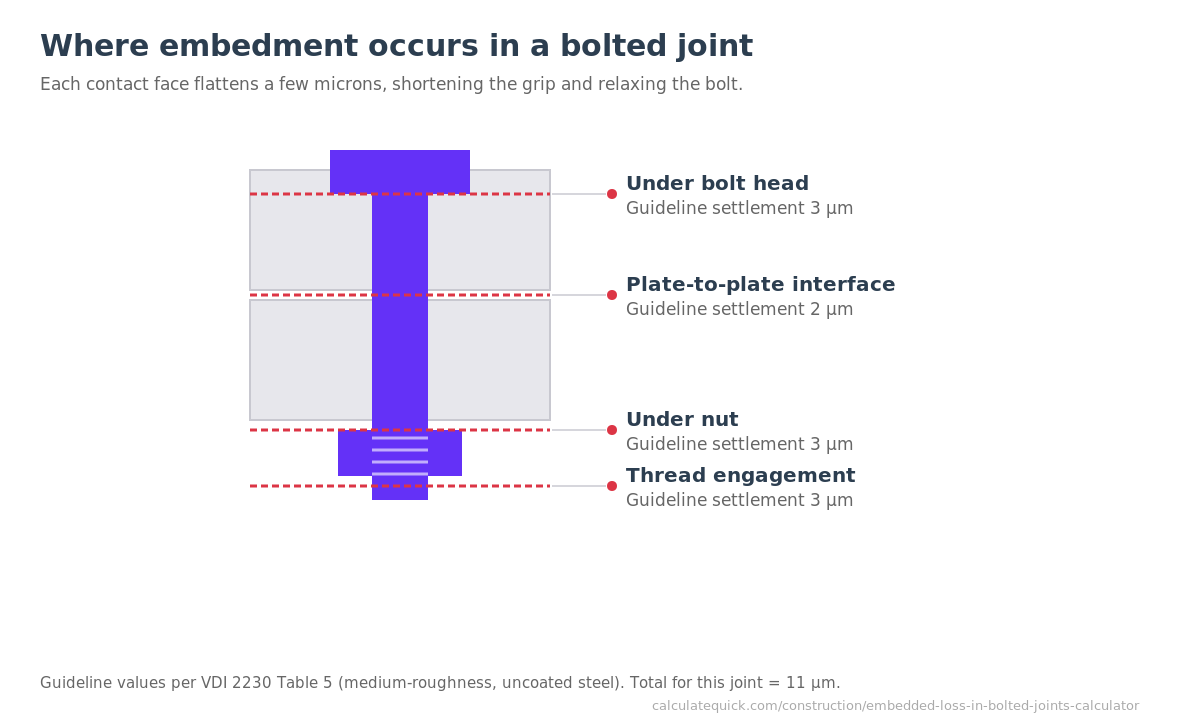
Every contact face flattens slightly under the clamp load. The grip stack gets shorter by the total embedment, and the bolt loses that much stretch.
Bolt size vs preload loss
Same joint, same surfaces and grip ratio, different bolt size. Embedment stays roughly constant in microns, but smaller bolts hold far less preload, so they lose a much larger share of it.
What this means for your joint
Calculating Embedment Loss in a Bolted Joint
Start in Quick mode. Pick the bolt size and grade, type in the grip length (the total thickness of everything clamped between the head and the nut), set how hard you tightened it as a percentage of yield, choose a surface roughness band, and say how many plates are stacked. The result panel updates as you type: the percentage of preload lost, the loss in kilonewtons, the clamp force left behind, and the total settlement in microns.
Switch to Advanced mode when you know more about the joint. It opens up the clamped material (aluminum and other soft metals settle more than steel), axial versus shear loading, tapped holes instead of a nut, added washers, surface coatings, and three ways to define preload: percent of yield, a measured clamp force, or a tightening torque with a nut factor. The diagram beneath the calculator marks every contact face and the microns it contributes, and the bar chart shows the same joint scaled across bolt sizes so you can see how the percentage moves.
Where Embedment Occurs in the Joint
A machined face looks flat but is covered in microscopic peaks called asperities. When two faces meet, they only touch at those peaks, so the real contact area is a small fraction of the apparent area. The clamp load concentrates on those tiny points, drives the local stress past the yield strength of the metal, and flattens them. That flattening is embedment. It happens at every interface in the stack: the thread flanks, the face under the bolt head, the face under the nut, and each plate-to-plate joint.
Some of it occurs while you are still tightening, and further tightening compensates for that, so it costs no preload. The part that matters happens after you stop, and most of it arrives during the first working load cycle, which may be hours or days later. As the peaks flatten, the grip stack gets a few microns shorter. The bolt was stretched like a stiff spring to create the clamp force, so when the stack shortens, the bolt relaxes by the same amount and loses tension. No nut has turned. Published guidance puts the settlement at roughly 1 to 7 microns per interface depending on roughness, which is why a joint with more faying surfaces loses more.
Typical Embedment Values and Preload Loss
Most everyday metal joints shed somewhere between 5 and 18 percent of their preload to embedment. The calculator builds the total settlement the way VDI 2230, the German bolted-joint standard, does: it adds a guideline value for each interface rather than applying one blanket figure. The per-interface values for uncoated steel are below, in microns.
| Surface roughness (Rz) | Loading | Thread | Per head or nut face | Per inner interface |
|---|---|---|---|---|
| Below 10 µm | Axial | 3 | 2.5 | 1.5 |
| Below 10 µm | Shear | 3 | 3 | 2 |
| 10 to 40 µm | Axial | 3 | 3 | 2 |
| 10 to 40 µm | Shear | 3 | 4.5 | 2.5 |
| 40 to 160 µm | Axial | 3 | 4 | 3 |
| 40 to 160 µm | Shear | 3 | 6.5 | 3.5 |
A plain steel joint with two plates, a bolt and a nut at medium roughness adds up to about 11 microns: 3 for the thread, 3 each under the head and nut, and 2 for the single plate interface. Run that through an M10 at 75 percent of yield and you land near a 13 percent loss. Shear loading, rougher faces, soft metals and thick coatings all push the total higher. The standard’s values are for uncoated steel; a painted or galvanized face can add tens of microns on its own, and aluminum members settle markedly more than steel for the same clamp load.
Bolt Diameter and Percentage Loss
The microns of settlement are roughly the same whether you use a fat bolt or a thin one, because they depend on the surfaces, not the bolt. What changes is how much preload those microns represent. Preload scales with the bolt’s cross-sectional area, which grows with the square of the diameter, so a small bolt holds far less clamp force to begin with and loses a much bigger share of it.
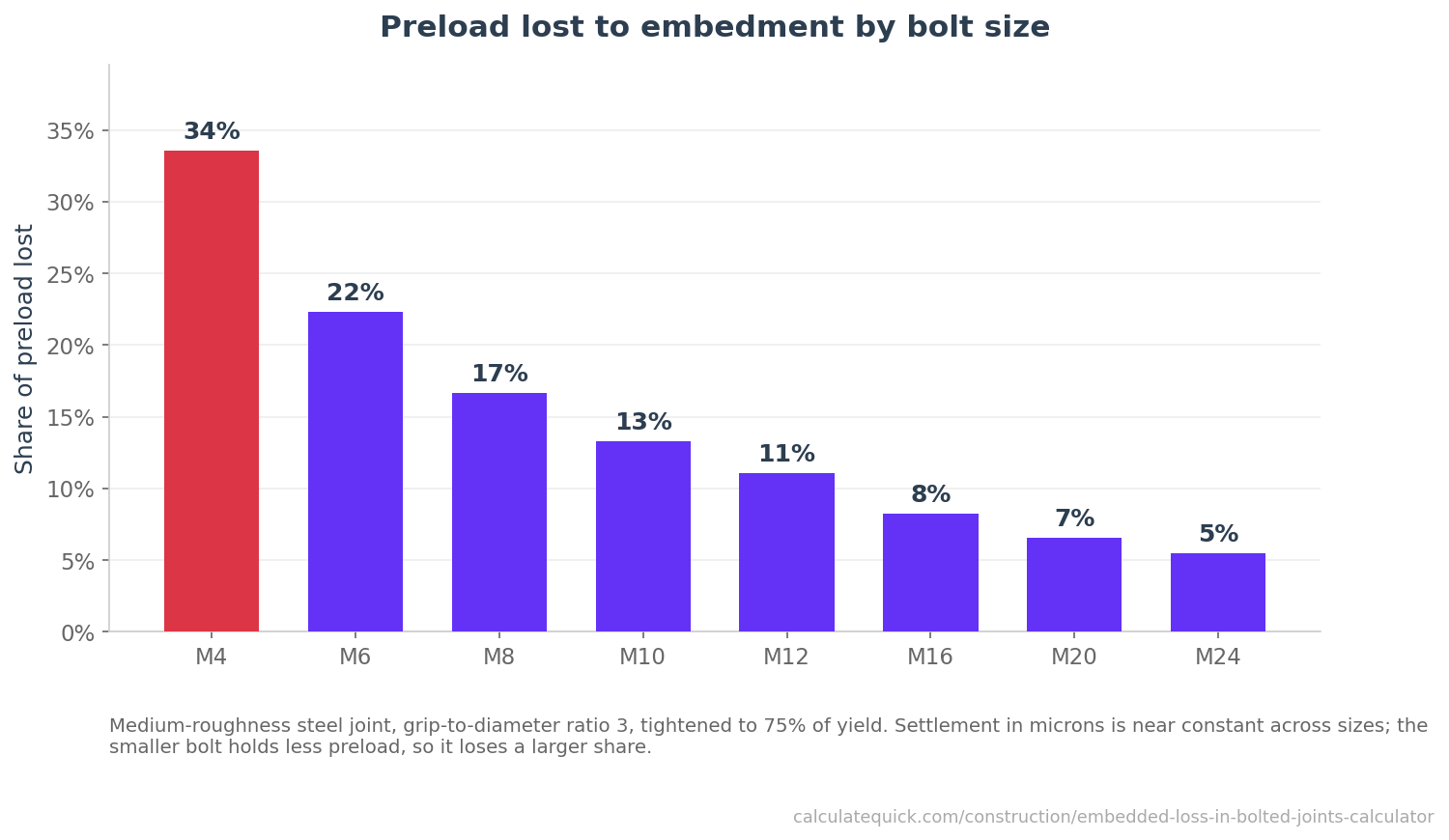
The difference between sizes is large. For the same grip ratio and surfaces, an M12 joint might give up around 12 percent of its preload while an M4 gives up close to 38 percent. This is why tiny screws are hard to keep tight, and why a thread-locking compound will not save them: the preload is leaking away without any rotation for a locking feature to resist. The fix has to change the joint’s stiffness or elasticity, not its friction.
Reducing Embedment Loss
The most direct answer is to re-tighten once the joint has seen its first load. Carmakers do exactly this when they ask for wheel bolts to be checked after the first 50 to 100 miles. Where re-tightening is impractical, the loss has to be designed out from the start.
Raising the elasticity of the bolting system is the most effective move. Add a conical spring (Belleville) washer and the stack can stretch far more for the same clamp force, so the same few microns of settlement become a tiny fraction of the preload instead of a large one. Solon gives a clean example: a half-inch bolt over a one-inch grip stretches about 0.002 inch, so a 10 percent embedment loss is roughly 0.0002 inch of give; add a Belleville that stretches 0.022 inch and that same 0.0002 inch is under 1 percent. Beyond springs, the levers are: use fewer faying surfaces, since each interface adds settlement; specify smoother faces under the head, nut and at the inner joints; lengthen the grip or choose a more elastic bolt to raise the grip-to-diameter ratio; and avoid stacking washers or laying down thick, soft coatings that crush. Then set your assembly preload high enough that the joint still has adequate clamp force after the loss.
Material choice matters on both sides of the joint. Clamped steel sections behave close to the standard’s steel values, while aluminum and other soft metals settle noticeably more for the same clamp load and need a larger allowance. Timber members and gasketed joints embed far more again. Coatings work the same way: a thin plating adds little, but a thick galvanized layer or a soft paint film can contribute tens of microns on its own as it crushes under the bearing faces.
Calculation Limits and Measuring Residual Preload
Treat the result as a first-pass estimate, not a guarantee. The weak link is the settlement itself: predicting how many microns a particular surface, coating and load history will produce is genuinely hard, and the clamped-part stiffness depends on real geometry that a cone model only approximates. The calculator is built on the recognized VDI 2230 method and validated against published joint-stiffness examples, so it lands in the right range, but the range is wide.
For anything that has to stay sealed, carry fatigue load, or hold safety-critical clamp force, confirm the residual preload by measurement rather than trusting a figure. Ultrasonic bolt-tension meters read the actual bolt stretch before and after settling and give you the real loss for that specific joint. Use the calculator to understand the joint and steer the design, lean on VDI 2230 or a validated tool for a design-grade number, and measure when the consequences of being wrong are serious.