Calculating DeepSeek API Costs
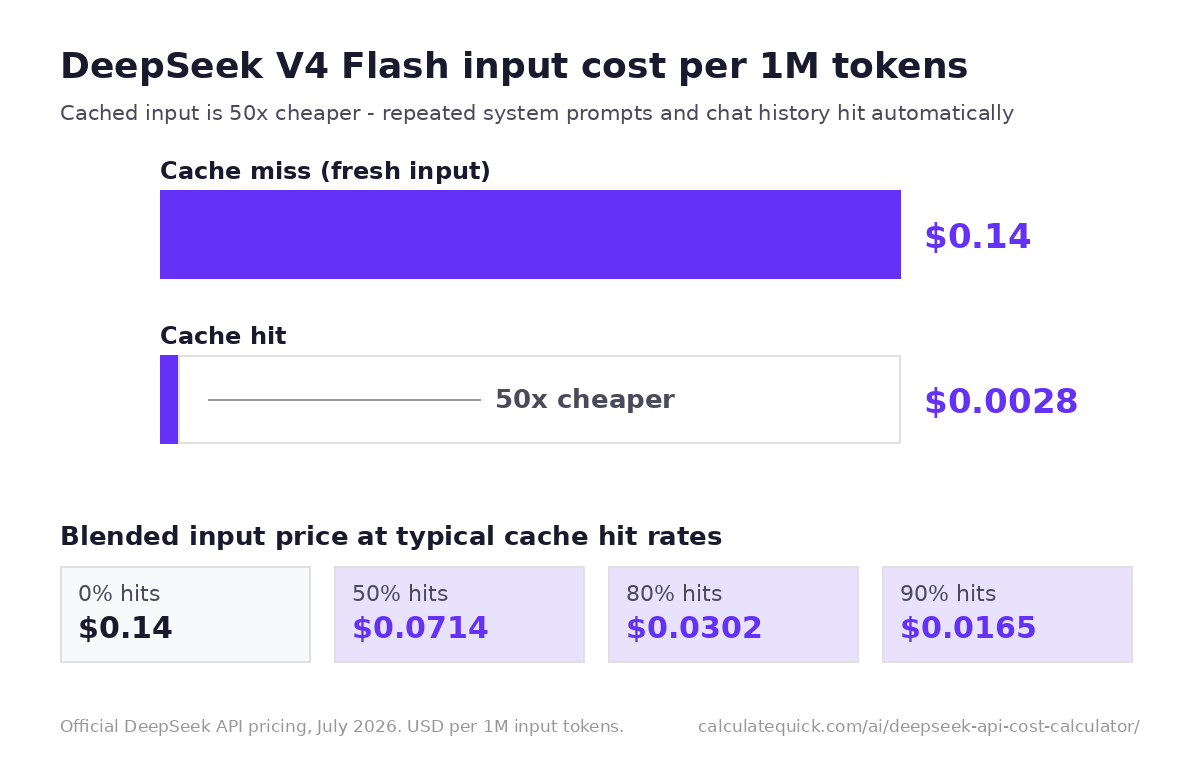
DeepSeek bills per token: you pay one rate for the tokens you send (input) and a higher rate for the tokens the model generates (output). Enter your typical request size above, set how many calls you make per month, and the calculator returns the cost per request and per month. The cache hit slider matters more than anything else on the page – input tokens served from DeepSeek’s automatic cache cost 50 times less than fresh ones.
A worked example: a support bot on V4 Flash sending 100,000 input tokens and generating 10,000 output tokens per conversation costs $0.0168 per conversation with no cache hits. At 30,000 conversations a month that is $504. If 80% of that input is repeated context served from cache – normal for multi-turn chat with a fixed system prompt – the monthly bill drops to $240.
DeepSeek V4 Pricing
Prices below are from DeepSeek’s official pricing documentation, checked July 3, 2026. Both models take 1 million tokens of context and can generate up to 384,000 output tokens per request.
| Model | Input (cache hit) | Input (cache miss) | Output | Concurrency |
|---|---|---|---|---|
| deepseek-v4-flash | $0.0028 | $0.14 | $0.28 | 2,500 |
| deepseek-v4-pro | $0.003625 | $0.435 | $0.87 | 500 |
All prices per 1 million tokens, USD. DeepSeek deducts fees from your topped-up balance, using any granted balance first.
If your code still uses the model names deepseek-chat or deepseek-reasoner, they currently map to V4 Flash in non-thinking and thinking mode respectively, and both aliases are deprecated on July 24, 2026. Move to the deepseek-v4-flash and deepseek-v4-pro names before then.
Cache Hit Pricing
DeepSeek caches request context automatically – there is nothing to configure. When part of your input matches something the API processed recently, those tokens bill at the cache-hit rate: $0.0028 instead of $0.14 per million on V4 Flash. The parts that usually hit are the ones that repeat between requests: system prompts, tool definitions, documents you keep re-sending, and the growing history of a multi-turn conversation.
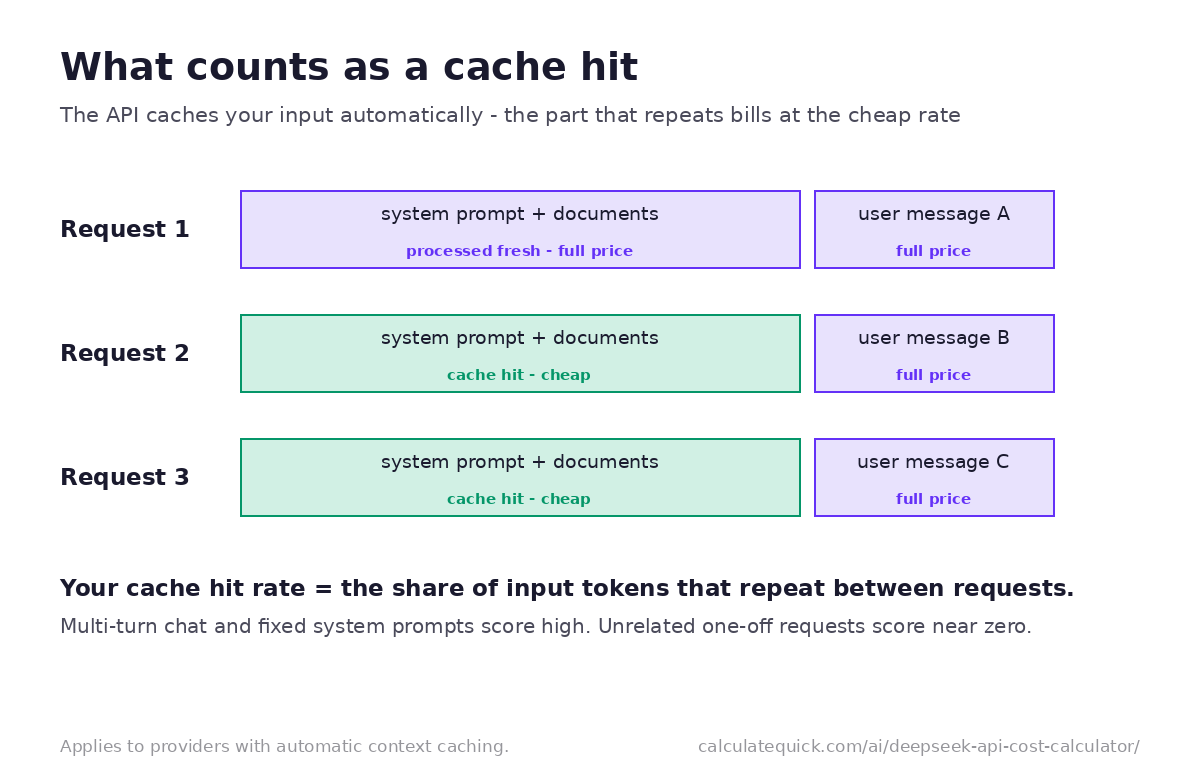
What hit rate to enter in the calculator depends on the workload. One-off, unrelated requests get close to 0%. A chat application where each turn re-sends the whole conversation typically lands high, because everything except the newest message was already processed – 70 to 90% is realistic. A RAG pipeline that stuffs different retrieved documents into every request sits low unless the shared instructions dominate. If you already run traffic, skip the guessing: the API’s returned usage data reports cached and uncached input tokens per request, and DeepSeek recommends reading real usage from there.
Thinking Mode Billing
Both V4 models can run in thinking mode, where the model works through reasoning tokens before writing its answer. There is no separate price for reasoning: DeepSeek bills those tokens as ordinary output. The API returns them in a separate reasoning_content field, so you can see exactly how much of your output bill is reasoning.
Reasoning volume varies with task difficulty and the effort setting (high is the default; some complex agent requests are automatically raised to max). Simple extraction tasks might add a few hundred reasoning tokens; hard math or multi-step agent work can add several thousand per request. On V4 Flash that is cheap – 5,000 reasoning tokens cost $0.0014 – but at Pro rates and high volume it compounds, which is why the calculator lets you budget it explicitly. For latency-sensitive or trivially simple tasks, non-thinking mode skips the reasoning cost entirely.
Is DeepSeek Free?
The chat app at deepseek.com is free to use. The API is not: every token bills against a balance you top up, and DeepSeek’s pricing docs (as of July 3, 2026) publish no standing free tier for API usage. New accounts have sometimes received a small granted balance – the docs mention granted balance being spent before topped-up balance – but that is a one-time credit, not an ongoing free allowance. Several third-party sites still describe a DeepSeek API free tier; the official pricing page does not back that up.
The same July 2026 documentation check found no active off-peak discount. DeepSeek ran time-of-day discounts in the past, and older articles still cite them, but the current pricing page lists flat rates around the clock.
DeepSeek Prices Compared With Other APIs
DeepSeek’s position in the market is price. V4 Flash undercuts every major Western model at list price: it is roughly 7 times cheaper than Claude Haiku 4.5 on input and about 20 times cheaper than Claude Sonnet’s standard rate. If you are weighing DeepSeek against Anthropic’s models for the same workload, run the same token numbers through the Claude API token cost calculator – it models Claude-specific billing like prompt caching TTLs and batch discounts that change the comparison materially.
| Model | Input / 1M | Output / 1M |
|---|---|---|
| DeepSeek V4 Flash | $0.14 | $0.28 |
| DeepSeek V4 Pro | $0.435 | $0.87 |
| Kimi K2.6 (Moonshot) | $0.95 | $4.00 |
| Claude Haiku 4.5 | $1.00 | $5.00 |
| Claude Sonnet 4.6 | $3.00 | $15.00 |
Cache-miss input rates, official provider pricing pages, July 3, 2026. List price is not the whole story: caching, batch discounts, and how many tokens each model’s tokenizer produces for the same text all shift real bills.
Keeping the Bill Down
Structure prompts so the stable part comes first and stays byte-identical between requests – the cache matches repeated context, and a system prompt that never changes is a guaranteed hit after the first call. Trim conversation history you no longer need instead of re-sending all of it forever; past a point, old turns cost input tokens without improving answers. Use non-thinking mode for classification, extraction, and reformatting jobs – reasoning tokens buy nothing there. And check the usage block on real responses weekly rather than trusting estimates: DeepSeek’s own guidance is that character-to-token ratios (roughly 0.3 tokens per English character) are approximations, and actual billing follows the returned counts.
If you are scaling up, note the concurrency column in the pricing table: Flash allows 2,500 simultaneous requests, Pro allows 500. Bursty batch jobs that exceed those limits queue or fail rather than costing more – the constraint shows up as throughput, not money.